Showing posts with label William Faulkner. Show all posts

New Orleans Literary Tourism

Wednesday, February 13, 2019

In May 2018 I finally got to visit New Orleans. I'd been dying to explore it for years and was thrilled to get to take a short girls trip there. The city's literary history is rich and I had a few must see spots on my list. 
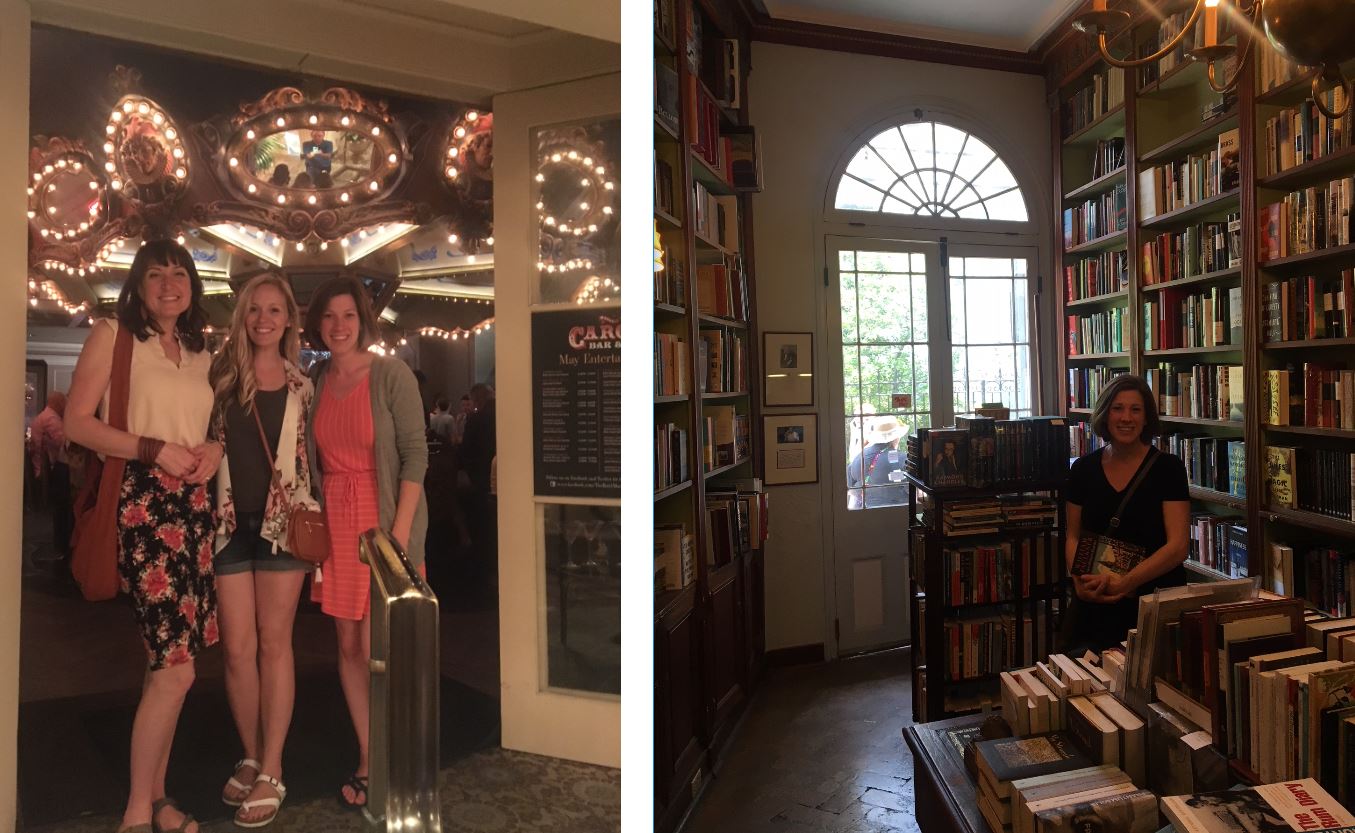
Faulkner Books was the one I was the most excited about. It's a perfect little bookstore located down a quiet side street near Jackson Square in the heart of the French Quarter. William Faulkner lived in the home in 1925 and it is filled with gems from his life. After exploring the stacks for awhile I purchased a copy of Faulkner's "New Orleans Sketches" and the short story, "A Pair of Silk Stockings" by Kate Chopin for myself and Mary Poppins for my daughter. Books are always my favorite souvenirs from a trip. 
In addition to an excellent selection of books, there are framed letters from famous writers like Hemingway, Flannery O'Connor, and Tennessee Williams. There were first editions of Faulkner's books (including the ones above). They were locked in a glass case, but the man working there let me look at them. They were worth thousands! The bookstore was completely charming and I'm so glad we made it there.
The other literary highlight of the trip was the Carousel Bar in the Hotel Monteleone. It's literally a carousel that rotates very slowly in the hotel lobby. It was a popular hangout for authors like Truman Capote, Fitzgerald, Eudora Welty, Tennessee Williams, and others. We got there early enough to grab a seat on the carousel and I sipped on my sazerac while we slowly turned. I loved it! There's a display in the lobby featuring books and photos of the famous authors who have been guests at the hotel. 

All-in-all New Orleans was wonderful. Filled to the brim with delicious food, great music, a cemetery tour, and time to wander the unique streets. Highly recommended!

Reading the States: Mississippi

Friday, June 22, 2012


State: MISSISSIPPI

Fiction:
- The Help* by Kathryn Stockett  
- A Time to Kill* by John Grisham 
- Crooked Letter, Crooked Letter* by Tom Franklin
- The Year of Jubilo by Howard Bahr 
- The Optimist’s Daughter* by Eudora Welty 
- As I Lay Dying* by William Faulkner 
- Mudbound by Hillary Jordan 
- Roll of Thunder, Hear My Cry* by Mildred D. Taylor 
- Mother of Pearl by Melinda Haynes 
- Jewel by Brett Lott
- The Sound and the Fury* by William Faulkner
- The Robber Bridegroom by Eudora Welty 
- Long Division by Kiese Laymon

Nonfiction:
- The Last Train North by Clifton L. Taulbert
- Ever Is A Long Time by W. Ralph Eubanks 
- Delta Blues by Ted Gioia
- Coming of Age in Mississippi by Anne Moody 
- Black Boy* by Richard Wright

Authors Known for Writing in or about the State:
- John Grisham
- William Faulkner   

Authors Who Lived Here: 
- Tennessee Williams  
- Eudora Welty  
- Richard Ford 

Great Bookstores: 
Square Books 
Lemuria Books

*Books I've Read 

Photo by moi.

As I Lay Dying

Monday, June 18, 2012


As I Lay Dying
by William Faulkner
★★★★

Faulkner, why do you make my brain spin in such a disorienting way? This novel, like many of Faulkner’s books, has multiple narrators telling a story that is centered around one major event. In this case, Addie Bundren is dying and she has asked her husband and adult children to travel to another county in Mississippi with her body to bury her in her hometown when she dies.

The thing about Faulkner is that you often don’t know where you stand with his books. His work seems intentionally obtuse, almost like he doesn’t want you to understand what’s going on; he’s famous for this. His narrators are often unreliable, sometimes because they are lying to the reader and distorting the truth until it’s unrecognizable (Absalom, Absalom). Other times it’s because the narrators themselves are confused (The Sound and the Fury). In this book you have a bit of both. Everyone has their own agenda and they tell their story while hiding their secrets from each other and sometimes the reader.

I’ll admit, usually I’d prefer to know where I stand when I’m reading. There are certainly exceptions to this, but I tend to prefer narrators that I can trust. I really struggled to follow the flow of this book. I knew what was going on, but keeping everyone (and their back stories and motivations) straight is difficult. There are so many characters and as we progress across the state with Addie’s coffin in tow, we learn how each character has reached this point in their lives. None of them seem happy with their lot in life and it’s not hard to understand why.

The thing that always redeems Faulkner’s work for me is the descriptions. The writing is just so beautiful and that far outweighs the disjointed plot. His writing is poetic and since I struggle with poetry to begin with, it’s no hard to see why Faulkner is a stretch for me.

BOTTOM LINE:
Absolutely worth reading, it’s an American classic, but go into it knowing Faulkner is going to take you for a ride. Sit back and enjoy the words that will take you there and don’t get too stressed about the details along the way.
 
“I can remember how when I was young I believed death to be a phenomenon of the body; now I know it to be merely a function of the mind -- and that of the minds who suffer the bereavement. The nihilists say it is the end; the fundamentalists, the beginning; when in reality it is no more than a single tenant or family moving out of a tenement or a town.”

Absalom, Absalom

Friday, August 12, 2011


Absalom, Absalom!
by William Faulkner
★★★★

My only experience with Faulkner to date was The Sound and the Fury. While I found it a fascinating read, you can’t deny that it’s incredibly muddled. There are multiple points of view, one of which is a mentally handicapped person, which makes for a confusing flow to say the least. So I’ve been a bit hesitant to try anything else from the famous southern author.

This book tells the tragic story of Thomas Sutpen, a proud man determined to create an epic legacy. He builds a huge plantation, Sutpen’s Hundred, convinced that its success, along with having male children, will ensure his goal of becoming a “great” man. To reach this end he becomes blinded to the needs of those around him, blatantly disregarding the fate of others in his obsessive quest (I give a more detailed summary in the spoiler section). The book’s name comes from the Biblical tale of King David’s son Absalom, who tried to destroy his father’s empire. Like the old testament story, Faulkner’s book focuses on a patriarch’s sins which eventually bring pain and suffering to his children.

**SPOILER ALERT**

See if you can follow me here…
Thomas Sutpen marries a woman, Eulalia, in Haiti. He later finds out she’s part Negro and so he divorces her; leaving both his wife and their son, Charles Bon. He then travels to Mississippi where buys 100 acres of land and marries a woman named Ellen. He has two children, Judith and Henry, with her and believes he has the perfect male heir to continue his line.

Years later, Henry goes to the University of Mississippi where he befriends, Charles Bon, without knowing that he is his half-brother. Henry takes Charles home to meet his family and Judith falls in love with him. Henry encourages the romance because he is a bit infatuated with both Charles and Judith and their union would allow him to live out his feelings vicariously. Charles realizes that Thomas is his father and thinks that Thomas will announce himself to Charles and welcome him into his home. This never happens and Charles decides to move forward with his plans to marry Judith.

Henry finds out, much to his horror, that Charles is his and Judith’s half-brother and begs Charles to leave her alone. When he refuses, Henry kills Charles to stop the marriage and then he runs away from home. Thomas’ empire is destroyed by the tragedy and he turns to the only women left around him in a desperate attempt to have another son. He fails and his callous disregard for those women leads to his murder.

**SPOILERS OVER**

Faulkner really makes you work for it. The narrative is hard to follow because the story is told by multiple characters, all of whom are relating the story to other people. The timeline bounces around because there are flashbacks and contradicting details and different points of view. It meanders about while trying to find its footing, but the rambling is very intentional. You’re supposed to get a bit lost as you get sucked into the story. Part of the reason it’s interesting is that you don’t know exactly what’s true. A large portion of the story is told by Quentin Compson (a character from The Sound and the Fury) to his Harvard roommate Shreve, decades after the events have taken place. Another part is told by Rosa, Thomas’ sister-in-law who has her own agenda and reasons for hating Sutpen.

Absalom, Absalom is a bit like watching a train wreck. You know it’s all going to end badly, but you can’t look away. Faulkner’s writing is beautiful, but again, it’s not a clear narrative because you’re never sure whether what you’re hearing is fact or someone’s opinion or just rumors. The scope of the story is epic. It touches on a dozen complex topics, including slavery, southern prejudice, devotion to land, incest, the downfall of the South, material wealth vs. familial love, etc. all the while mapping out a complicated tragedy of Greek proportions.

So far I haven’t loved reading Faulkner. I’ve been captivated by his work and it makes me feel like I’m wandering through decrepit old southern mansion as I read it, but I don’t feel passionate about it. This book kind of defies my rating system, because I didn’t love reading it, but it really challenged me and I thought about it long after I finished it. I like it when books do that to me.

I’d like to try another one of his next year and see how that goes. I’m thinking maybe As I Lay Dying of Light in August. Do you guys have any strong feelings about which Faulkner books I should try? The next one might decide whether I pursue him further or not.

"Jesus, the South is fine, isn't it. It's better than the theatre, isn't it. It's better than Ben Hur, isn't it"