Showing posts with label Read-Along. Show all posts

The House at Riverton

Monday, November 26, 2012


The House at Riverton 
by Kate Morton
★★★★☆

Morton’s novels are always fun reads for me and this one didn’t disappoint. With shades of du Maurier’s Rebecca and the BBC’s Downton Abbey, the book was a wonderful mystery. I read this as part of the read-along hosted by Words and Peace, but I couldn’t manage to slow down long enough to keep to the reading schedule. Oh well.

We meet Grace at the end of her life. She is living out her days at a retirement home when she finds out a movie is being made about a dramatic event that happened in her youth. As a teenager Grace worked as a house maid at a large manor, Riverton, in the English countryside. A young poet committed suicide at the home one night and the mystery surrounding the evening has always left people wanting to know more. Grace decides it might be time to finally reveal the truth of what happened.

Like all of Morton’s novels, this one has themes of mother/daughter relationships, long-kept secrets and the English countryside. Grace’s mother used to work at Riverton and we slowly learn bits of her history as well.

After a few years at Riverton Grace becomes a lady’s maid for the Hartford sisters, Hannah and Emmeline. Their close relationship allows Grace to give us a wide-view of the happenings in the house. As the years pass and relationships become more complicated the story reminds us that one man’s happiness is another man’s prison.

I thought the relationship between Hannah and Emmeline was one of the most fascinating elements of the story. The relationship between sisters is like no other. It tends to be fraught with both love and jealousy, creating a strange and precarious balance. Morton captured this perfectly, allowing us to understand and sympathize with both sisters throughout the novel.
 
BOTTOM LINE:
I really enjoyed it. The Forgotten Garden is my favorite of her’s so far, but I have a theory that your first Morton is always your favorite. This one was the perfect book to give me a Downton Abbey fix until I can watch the third season. Curl up and read it while it's cold outside!

“‘No. Not a mystery. Just a nice safe history.’ Ah my darling. But there is no such thing.”

“…for home is a magnet that lures back even its most abstracted children.”

“It is an uncanny feeling, that rare occasion when one catches a glimpse of oneself in repose. An unguarded moment, stripped of artifice, when one forgets to fool even oneself.” 

“Reading is one of life’s great pleasures; talking about books keeps their worlds alive for longer.” (This last quote actually came form an interview with Morton at the end of my book)
 
You can’t find my thoughts on the beginning of the novel here.

House at Riverton Read-along

Monday, November 5, 2012


I think I've made it clear that I love Kate Morton's books. So when Words and Peace decided to host a read-along of one of her books that I hadn't read, The House at Riverton, I just had to join in. She posted a list of questions for everyone to answer. So here are both the questions and my answers. There might be some spoilers of Part 1.

On Part 1: from 'Ghosts Stir' to 'Until We Meet Again'

Please share your favorite lines:


“I was not a rebel – indeed, back then I had a fierce sense of duty – but to live without Holmes and Watson was unthinkable.”

“…for home is a magnet that lures back even its most abstracted children.”

“It is an uncanny feeling, that rare occasion when one catches a glimpse of oneself in repose. An unguarded moment, stripped of artifice, when one forgets to fool even oneself.”

Ghosts Stir:

What effect do the first 2 sentences have on you, as a reader?

It immediately reminded me of Rebecca by Daphne du Maurier.

Does this chapter draw you in? How does the author manage to do this?

Yes, it sets up the secrets and the mystery. I wanted to know how the main character’s life is woven in with the Hartford sisters.

The Nursery:


If you mentioned the title of another book in question #1, do you find here more things in common with that book?

Yes, a new person being introduced into a home, but this book is told from a servant’s POV instead of the lady of the house’s POV.

Waiting for the recital:

What’s your feeling toward the Game?

It sounds like child’s play, but there’s some serious foreboding as well.

All Good Things:


Merriam-Webster describes “suspense” as “pleasant excitement as to a decision or outcome” of a novel. How does the author create the suspense here?

She shows Hannah attempting to push the boundaries with her father and the war starts.

Morton often integrates the themes of memory, relationships between generations, secret, in her novels. How has she worked them, and other themes you may have identified, in this story?

The story is all about Grace’s secret, her relationship with her own mother and relationship with her daughter. That theme echoes all of Morton’s other books.

In The West:

What do you like most in this chapter?

I loved meeting Robbie and learning about his history; his mother the Spanish maid and his father, a wealthy Lord.

Until We Meet Again:

How would you define what a Gothic novel is? Does your definition apply to the first chapter of this book? Why or why not?

Gothic novels are defined as “a genre or mode of literature that combines elements of both horror and romance.” I think this book definitely fits into this category because it combines multiple romances (Alfred, Teddy, etc.) with mysteries. It’s also very atmospheric, set in a huge English manor with the memory of a death hanging over everyone.

*** *** ***

Next up are the following sections. I'll be following everyone else's posts on Nov. 12 and 19, but I will save my thoughts for a final post on Nov. 26. I finished the book and I don't want to confuse the sections in earlier posts. Happy reading!

November 12: Part 2 – from 'The Twelfth of July' to 'The Ball And After'
November 19: Part 3 – from 'Catching Butterflies' to 'The Choice'
November 26: Part 4 – from 'Hannah's Story' to the end


Moby Dick Readalong: Final Post

Thursday, February 2, 2012


Moby Dick

by Herman Melville
★★★★☆

“We do not judge a masterpiece by its flaws, but by its virtues.”

That line is included in the introduction to my copy of Moby Dick and it was an incredibly helpful thing to remember. In my opinion, the book is flawed, of course it is. It’s a massive undertaking that covers many themes, writing styles and subjects. Melville was incredibly ambitious in what he tried to do with the novel and in taking on so many different formats and points-of-view, some of them inevitably failed, but in spite of that, the book has an undeniable magnetism.

At times I felt like I was slogging through chapters. It was a bit like cross country skiing. It’s hard work, occasionally you hit a slick spot a slide along quickly, but mainly you're just pulling yourself forward slowly, with all of your energy and strength. Then the final 20 chapters were like a downhill streak. They went so quickly that it almost made me forget the struggle through the middle section.

I was incredibly glad I read this for the read-along hosted by The Blue Bookcase. Knowing that I had weekly deadlines and discussions was a great motivation to pick it up when I didn’t feel like it.

“Consider the subtleness of the sea; how its most dreaded creatures glide under water, unapparent for the most part, and treacherously hidden beneath the loveliest tints of azure.”

The main thing I took away from this book was the beauty of the writing, like the above quote. Sometimes Melville would ramble on about the details of whale anatomy or the perils of the whaling profession, but he does it in such an eloquent way. Every time I got a bit bogged down in all Melville's facts and ideas, his writing grounded me. He has a beautiful way of phrasing things, but it often seemed like he couldn’t decide whether he wanted to educate or entertain his readers. In chapters like 32, where he gave a lesson in the different types of whales, I got bored. Then, a few chapter later in 42, he talked about the whiteness of the whale and how that heightens its terrifying nature because white is a color we associate with beauty, innocence, royalty, etc. When that’s paired with a murderous beast it makes it all the more horrifying.

“…that heightened hideousness, it might be said, only rises from the circumstance, that the irresponsible ferociousness of the creature stands invested in the fleece of celestial innocence and love; and hence, by bringing together two such opposite emotions in our minds, the Polar bear frightens us with so unnatural a contrast. But even assuming all this to be true; yet, were it not for the whiteness, you would not have that intensified terror.”


On to some of the specifics in the book, which will include some SPOILERS.

I was really glad Melville explained exactly how they track Moby Dick, because finding a specific whale in a vast ocean seemed far-fetched to me at first. Once he explained how they track the drifting of the whale’s food and the tides it made a lot more sense.

I think the fact that Ahab had a wife and child makes his madness so much more tragic. Towards the end he talks about the fact that he widowed his wife the day he married her. I’ve heard of a book called Ahab’s Wife and now I’m curious if that’s any good. Has anyone read it?

For me, the pinnacle of Ahab’s madness came in ch.128 when he turns down the request from a captain of a fellow whaling ship (the Rachel) to help look for his 12-year-old son that is on a missing boat. This is the first time Ahab's obsession really hurts someone else. He makes a conscience decision to choose his pursuit of the whale over helping someone in need and to me that proves that he's lost all perspective. He's refusing to help a man find his son, when he is a father and should know how important this is. This is where he crosses the line and he never really returns from that decision. In a strange way Ahab is both the villain and hero of the book. He is admired and feared, triumphant and broken. He has survived a whale attack, but can’t seem to move on with his life. He must have been a good captain at some point to gain the loyalty and respect of Starbuck, but we never really see that side of him.

“For all men tragically great are made so through a certain morbidness. Be sure of this, O young ambition, all mortal greatness is but disease.”

I am so grateful for Melville's sense of humor. The book has some wonderful elements, but without a bit of humor I think it would have felt incredibly heavy. The first section is the most entertaining, but Melville throws a few comedic bits in every so often. I thought the section about Queequeg’s coffin was hilarious. The harpooner is near death with sickness and requests a coffin be made for his burial. Then, after lying in it to confirm it will suffice, he miraculously recovers, declaring that anyone can get better if they decide to. Then he uses the coffin to store his belongings in! That wry sense of humor was sprinkled throughout the book, especially at the beginning.

“Heaven have mercy on all of us – Presbyterians and Pagans alike – for we are all somehow dreadfully cracked in the head, and sadly need mending.”

In the end of the story the coffin returns to save Ishmael’s life. How amazing that something created for one man’s death ends up being another man’s salvation. I’m still in shock when I think about what Ishmael experienced when he watched his friends and shipmates die and was then stranded in the ocean, surrounded by sharks, for two days. It seems like madness would be inevitable.

Melville created a wide and strange cast of characters; Ahab, Ishmael, Queequeg, Bildad, Tashtego, Daggoo, Peleg, Starbuck, Stubb, Flask, and all the others connected with the ill-fated Pequod. They grew on me throughout the story, especially Starbuck with his misplaced loyalty to Ahab. He had a lot of wisdom.

“‘I will have no man in my boat,’ said Starbuck, ‘who is not afraid of a whale.’ By this, he seemed to mean, not only that the most reliable and useful courage was that which arises from the fair estimation of the encountered peril, but that an utterly fearless man is a far more dangerous comrade than a coward.”

There are so many breath-taking descriptions in this book. The mother whales nursing, the two dead whale heads hanging off the Pequod, the descriptions of whales’ eyes and ears. All of it was odd, but also interesting. Melville brought a foreign world into my home and made me feel like I was seeing these strange new sights along with Ishmael.

The murder of the old whale in ch.81 is one particularly vicious example of this. It shocks not only the reader, but Ishmael too. After pages and pages of hearing about it in theory, to see the kill actually happen is startling and makes it all seem so much more real.

“For all his old age, and his one arm, and his blind eyes, he must die the death and be murdered, in order to light the gay bridals and other merry-makings of men, and also to illuminate the solemn churches that preach unconditional inoffensiveness by all to all.

As we near the end of the story Starbuck’s desperate attempts to shake Ahab from his obsession are heartbreaking. He tries again and again to make him turn back and drives the point home by saying that Moby Dick is not pursuing Ahab. It’s easy to forget this because Moby Dick is painted as the villain, lashing out against Ahab and taking his leg. In reality, he is just a whale trying to save himself. It’s Ahab’s one-sided fight and his actions have tragic repercussions for everyone else.

When people talk about Moby Dick they always say it isn't really about a whale and I always thought that was silly. I thought, well yes, I get that there are other issues and themes, but really, it is about a whale. But now I understand, the hunt for the whale is part of the story, but it is seriously about so much more than that.

I have always been curious about this book and I’m so glad I finally read it. My curiosity has been sated and it lived up to my expectations. Yes, there are parts that drag. Yes, he talks a LOT about whaling. Yes, there is not a clear A to B kind of plot and the characters fade in and out of the narrative. But as much as Melville meanders and pontificates, in the end he’s created an epic story. It’s about obsession, man’s relationship with nature, revenge, religion, insanity and so much more.

And it is one strangely enthralling tale.

I’ll leave you with one of those amazing lines that made me fall for the book…

“These are the times of dreamy quietude, when beholding the tranquil beauty and brilliancy of the ocean’s skin, one forgets the tiger heart that pants beneath it; and would not willingly remember, that this velvet paw but conceals a remorseless fang.”

Here’s the link to my first post.

p.s. I made one exception to my clothes buying ban to get the Out of Print Moby Dick t-shirt I'm wearing in the pic above. It was my present (to myself) for finishing the book and I used a gift card, so that doesn’t count, right?

Photo by the Huz

Moby Dick Readalong: Part One

Thursday, January 12, 2012


I made it through the first section of Moby Dick for the readalong hosted by The Blue Bookcase! I have been meaning to read this one for years and this provided the perfect motivation to kick me into gear.

Here's the reading schedule...

Jan 12: Chapters 1-28
Jan 19: Chapters 29-55
Jan 26: Chapters 56-93
Feb 2: Chapter 94-epilogue

I'm going to keep my thoughts to a minimum because I feel like I'm still getting acquainted with the book and the characters. So far I've really enjoyed it. Each chapter is incredibly different, but interesting. Allie at A Literary Odyssey gave me some great advice when she said to think of each chapter as a short story. That allowed me to stop trying to force the plot to progress and just enjoy Melville's wander tangents more.

A couple things I enjoyed in this first section:

- Our narrator Ishmael's terrified night anticipating his "pagan" roommate at a boarding house. Then he and said pagan, Queequeg, ended up becoming fast friends.

- People keep screwing up Queequeg's name. They called him Hedgehog and Quohog.

- Everyone is giving some fascinating accounts of Captain Ahab, but we don't actually know him yet.

- I had no idea Ahab had a wife and kid. I always pictured him as a crazy loner with a whale obsession. The family aspect makes him much more relatable.

I'll leave you with one of my favorite quotes from the first quarter of the book.

"With other men, perhaps, such things would not have been inducements; but as for me, I am tormented with an everlasting itch for things remote. I love to sail forbidden seas, and land on barbarous coasts."

Harry Potter and the Deathly Hallows

Friday, July 15, 2011


As I’m sure you all already know, the final installment of the Harry Potter movies is being released today. It has been 10 years since I picked up the first book in 2001 and fell in love with the series. Since then I’ve read all seven books multiple times, then listen to them all again on audio. I’ve attending midnight book release parties and even went to the red carpet premier of the fourth film in London. I’ve seen all of the movies and debated the merits of the different directors and different Dumbledores.

All-in-all, this series has provided some of the most important literary milestones in my life. There are few other books that I have loved as much as these. I felt like I’ve watched the characters grow up and now that’s coming to an end it feels so bittersweet. I can’t wait to see the final movie, especially after finishing the seventh book, but I will miss having more Potter related things to look forward to. Luckily I know the books will always be there for me whenever I feel like revisiting the wizarding world.

**If you haven’t read this book, just skip this review. I tried to avoid spoilers, but there is just too much to talk about.**

Harry Potter and the Deathly Hallows
by J.K. Rowling
★★★★★

The wizarding world is in the midst of a war and Harry, Ron and Hermione are on a quest to find and destroy the remaining horcruxes. The seventh book is the only one that does not take place mainly at Hogwarts, instead it winds from the dank rooms of Grimmauld Place to the quiet streets of Godric’s Hollow to the vaults of Gringotts Bank. We do return to Hogwarts, but not for classes. In this final chapter of Harry’s story, everything is on the line. He must defeat Voldemort once and for all or die trying.

I love this book for so many reasons. We finally learn the whole truth about Snape, we see Voldemort’s downfall, Ron and Hermione finally make it official, Mrs. Weasley’s wonderful line to Bellatrix, and so many other reasons. Just as it happens in any war, there are also casualties. Even though I knew what was going to happen, I couldn’t help crying at a few points; Hedwig’s death, the graveyard in Godric’s Hollow and the moment Harry walks into the forest with his parents, Sirius and Lupin, they get me every time.


This book shows exactly how much Harry has grown up over the course of the series. He’s always been willing to risk his life to save others, but the true sign of his maturity is his decision not to act. His hot head has gotten him in trouble in the past, but at the crucial moment, he has to decide whether or not to try to stop Voldemort from taking the elder wand from Dumbledore’s grave. He chooses not to, and though he second-guesses his decision, in the end he’s learned that he doesn’t have all the answers and jumping to conclusions or diving blindly into action is not always the best choice.

Though he died at the end of book six, Dumbledore features prominently in this book. Harry learns all about his mentor’s youth and misdeeds and he begins to doubt the man he has always admired. It would have been easy to end Dumbledore’s story without going into the details of his childhood or tarnishing Harry’s perfect picture of him, but I’m so glad Rowling decided to delve deeper into his life. No one is perfect and showing Dumbledore’s faults made him more human and accessible as a character.

After six years of rivalry, Potter chooses to save Malfoy (more than once) in the final moments. I loved that even though they hated each other, Harry’s goodness triumphs over petty revenge. By saving Malfoy, Harry is in turn saved by Narcissa, Draco’s mother, which once again proved that Voldemort never understood the power of a mother’s love for her child and he was undone by it.

I think it’s fascinating that Rowling included the concept of squibs in Harry Potter lore. How awful would it be to live in a world where everyone around you can do magic, but you are unable to. People like Filch live in the magical world, but they’re never truly part of it. It also puts a different twist on the “pure blood” mentality, because a witch or wizard could come from the perfect bloodline and still not be able to do magic.

One final note, I know many HP fans hated the epilogue, but I loved it. It might have been cheesy to give the books a happy ending, but to me it was perfect. It ended the series on a note of hope and gave us a glimpse into the future lives of the characters we all love so much.

A few things I'd forgotten about the seventh book:

1) Hermione puts the portrait of Phineas Nigellus in her bag and he’s the one who tells them he saw Dumbledore destroy the ring with the sword of Gryffindor.

2) Lupin offers to go with Harry and protect him on his mission. Harry is furious with him, because Lupin would knowingly be abandoning Tonks and their unborn child.

3) There’s a statue of Harry and his parents in Godric’s Hollow. There’s also a plaque at their destroyed home, which is covered with messages encouraging Harry.

4) When Harry is kind to Kreacher, after finding out he had to watch Regulus die, he becomes a brand new house elf, clean and helpful.

5) Harry was a descendent of the Peverells, the three brothers who originally owned the Deathly Hallows. Voldemort also might have been descended from them, because his grandfather owned the ring containing one of the hallows.

6) Luna painted pictures of Harry, Hermione, Ginny, Ron and Neville on the walls in her bedroom with the word “Friends” repeated over and over again.

7) Lupin asked Harry to be his son Ted’s godfather.

8) It was Ron’s idea to get all of the basilisk fangs from the Chamber of Secrets to destroy the final horcuxes.

"That which Voldemort does not value, he takes no trouble to comprehend. Of house-elves and children's tales, of love, loyalty, and innocence Voldemort knows and understands nothing."

Read for the Harry Potter Challenge hosted here.

Harry Potter and the Half-Blood Prince

Friday, June 24, 2011


**If you haven’t read this book, just skip this review. I tried to avoid spoilers, but there is just too much to talk about.**

Harry Potter and the Half-Blood Prince
by J.K. Rowling
★★★★★

I’d forgotten how much I adore this book. It’s one of my favorites of the whole series. The stakes are high as Voldemort begins his full-force attack. People are disappearing or dying and all of the main characters realize that they will probably lose some loved ones before it’s all said and done.

I love the way Rowling beings the book in the office of the British prime minister as he receives a visit from Fudge. It was the perfect way to catch readers up on all the mayhem that happened over the summer. It also helps us understand how the two ministries (magical and non) work together or at least touch base on occasion.

Harry’s trip to Slughorn’s with Dumbledore is incredibly awkward because they’ve never had a private conversation outside of Hogwarts. Also, their relationship changed forever at the end of Book 5, when Harry was broken-hearted and screamed and railed at Dumbledore. Throughout this book we watch their relationship deepen as they spend more time one-on-one and Dumbledore treats Harry more like an equal, instead of as a student. He is training Harry, like an apprentice, in what he’ll need to know to fight Voldemort.

I love the scenes where Dumbledore and Harry explore the memories that shed light on Tom Riddle’s transformation into Voldemort. We see his parents and horrible grandfather. We learn about his time at the orphanage and tendency towards violence before he even knew he was a wizard. We see him as a loveable, manipulative student and a charming young shop clerk. These scenes are what make Voldemort such a great villain. We see behind the curtain of pure evil into the roots of his desire for power and control.


Dumbledore was incredibly observant during his first meeting with Riddle. When he looks back on that memory he realizes just how much information he gathered. Tom liked to collect treasures from his victims; he had no friends and didn’t want help from anyone; he used magic to control and dominant others; he desperately wanted to be different and “special.” All of those elements are very much a part of Voldemort and help Dumbledore find his weaknesses.


During Christmas break Harry stands up to the new Minister, Scrimgeour, and sides with Dumbledore instead of the ministry. He shows such bravery and loyalty. I love the scene later when he tells Dumbledore about the exchange …

“He accused me of being ‘Dumbledore’s man through and through.’”
“How very rude of him.”
“I told him I was.”
Dumbledore opened his mouth to speak and then closed it again.

It always broke my heart the Dumbledore died at the end, but now on my fourth re-read, I think I finally understand why it was crucial for it to happen that way. Harry has to fight the final battle on his own. Dumbledore was the only other person who truly could have helped him, so he had to die for Harry’s path to become inevitable.

A few things I'd forgotten about the sixth book:

1) Harry’s the Quidditch captain this year. I honestly think I they could have cut out half of the Quidditch scenes in the series and I wouldn’t have noticed. I like the fact that they’re used to demonstrate things like Ron finding self-confidence, but I’m just not a big fan of those parts.

2) At Dumbledore’s funeral Harry has a strange urge to laugh. That’s such a relatable moment for me. When you’re grieving your emotions are so raw and laughter is nestled right to crying.

3) Ginny is so sassy in this book. She and Ron fight, she dates other guys and she stands up for her friends. I love how her relationship with Harry develops as he gets to know her better.

4) In one scene Mrs. Weasley says, “It was a lucky day for the Weasleys when Ron decided to sit in your compartment on the Hogwart’s Express, Harry.”
I feel like it was lucky for Harry as well, because Ron, with all his bumbling faults, is such a wonderful friend for Harry. He keeps him grounded in the normalcy of being a teen.

5) Dumbledore tells Harry he should tell Ron and Hermione exactly what the prophecy said, because he needs his friends. He’s so wise.


"But he understood at last what Dumbledore had been trying to tell him. It was, he thought, the difference between being dragged into the arena to face a battle to the death and walking into the arena with your head held high. Some people, perhaps, would say that there is little to choose between the two ways, but Dumbledore knew - and so do I, thought Harry, with a rush of fierce pride, and so did my parents - that there was all the difference in the world."

Read for the Harry Potter Challenge hosted here.

The Iliad

Thursday, June 2, 2011


The Iliad
by Homer
★★★★

Set in Ancient Greece, The Iliad is an epic poem about a decade-long war. The book starts when the Trojans and Achaeans have already been at war for years. The war itself begins because Paris (a Trojan), steals Helen, the wife of Menelaus (an Achaean). This gives the Achaeans an excuse to load up their ships and head to Troy to attack them. Helen is the woman behind the infamous “face that launched a thousand ships.”

***SPOILERS***

Paris’ brother Hector is a great warrior, unlike Paris, and because of this he leads the Trojan side of the battle. The Achaeans’ greatest warrior is Achilles, but a falling out with Agamemnon (Menelaus’ brother, leader of the Greeks) over spoils of war causes Achilles to refuse to fight. It’s not until Hector kills his close friend, Patroclus, that Achilles rejoins the war to avenge his friend’s death.

Confused yet? It’s pretty straight forward while you’re reading it, but it sounds convoluted when you try to summarize it. It’s considered the greatest war story ever told and so obviously there are a lot of battle scenes.

I really liked the moral dilemmas, but after awhile the battles seemed repetitive. I loved The Odyssey, (Homer’s book that followed one of the warriors on his journey home after the Trojan War), so much because it’s one man’s journey and every aspect of his adventure is new and unexpected. With the Iliad, Homer has to convey the exhaustion the men feel after fighting the same battle for years. The fatigue was contagious and I felt it about half way through the book. Things pick up towards the end because big players are dying and you know it’s all coming to a head.

The plot is frustrating at times, because the meddlesome gods cause more problems than they solve. They’re petty and territorial and they choose humans that they want to champion and they don’t care who is hurt along the way. It also seems to remove the element of free choice in the warriors; lives. They can choose to do something, but the gods will just prevent it from happening if they want to.

After Hector is killed there is a brief mention of Helen's loneliness. She was taken from her home and is treated horribly by most people in Troy because they see her as the reason for the war. Hector was always kind to her and she realizes that none of her only friends is now dead and the loneliness is overwhelming. Even though this is a tiny part, it was really poignant to me. She’s always painted as a guilty party in this legend, leaving her husband for another man, causing a war, etc. I never thought about how terrible her life must have been.

I couldn't believe that the infamous Trojan Horse makes no appearance in The Iliad. It's my own fault for assuming it was part of the book, but I kept waiting for that part ... and then it ended. Apparently the Trojan Horse in mentioned in The Odyssey, which I remember, and then the full story is found in The Aeneid by Virgil.

One of my favorite scenes in the book is the exchange between Priam and Achilles. Priam (Hector’s father) goes to talk to Achilles after his son is killed. He begs Achilles to let him have Hector’s body. The beauty of this scene is that it strips away ten-years of war and reduces the powerful Priam and Achilles to two grieving men. They aren’t on opposite ends of an epic battle; they’re just heartbroken individuals lamenting the cost of war.

***SPOILERS OVER***

In the end, The Iliad is a must read, not because it’s the best book ever, but because it’s a cornerstone of literature. It has provided the basis and inspiration for countless war stories in the centuries since its creation. It’s one of the oldest and most well-known stories in existence and that’s not something anyone should miss. But I would recommend The Odyssey over The Iliad if you’re only going to read one, even though that story comes after this one in chronological order.

I read this as part of A Literary Odyssey’s read-along.

Harry Potter and the Order of the Phoenix

Friday, May 27, 2011


Harry Potter and the Order of the Phoenix
by J.K. Rowling
★★★★☆

**If you haven’t read this book, just skip this review. I tried to avoid spoilers, but there is just too much to talk about.**

The fifth installment of the Harry Potter series gets a lot of flack. Harry whines too much, it’s too long, too much Quidditch, Hagrid and Dumbledore are almost completely absent from the first 2/3 of the book, etc. I don’t disagree with these assessments and it’s always been one of my least favorite books of the series, (my least favorite HP novel is still one of my favorite books).

However, while re-reading it this month I’ve developed a real appreciation for Rowling’s portrayal of women. Clover’s post at Fluttering Butterflies had me thinking about the great female characters in Harry Potter and I feel like the Order of the Phoenix is the pinnacle example of this.

Not only do we have favorite characters like the brilliant Hermione, who’s wonderful in every book, but we meet many of the best women for the first time. Both Luna Lovegood, so wonderfully comfortable in her own skin, and Tonks, a young auror, equal parts friendly and clumsy, are newcomers in this novel. We also get to know Mrs. Weasley better. We learn how much she both cares for and fears for her family. She is fiercely protective of her loved ones.

Professor McGonagall is also an under-appreciated character. She has a steely reserve, and although she sometimes seems cold, she really loves the school and her students. Her undying loyalty to Dumbledore, in the harshest of circumstances, is inspiring. I loved how she stood up to Umbridge and told Harry she would help him become an auror if that’s what he wanted. She’s just wonderful.

We get to know Ginny better in this book as well. Instead of simply being the youngest Weasley and Ron’s little sister, she’s part of the story. She trains in Dumbledore’s Army and goes with the group to the Ministry of Magic in the end. She’s also protective of her friends, defending both Neville and Luna during this book.

Then there are the deliciously dark villains. We meet Bellatrix LeStrange, Voldemort’s devoted follower and Professor Umbridge, a sickly sweet atrocity, who believes the ends will always justify the means.

One thing I hadn’t thought about last time I read the series is Lupin’s loses. His three closet friends are all taken from him, first James, then Peter (so he thinks), and finally Sirius is taken to prison. Then he realizes Sirius is innocent and he gets him back, only to lose him again. Lupin is already a social outcast because he’s a werewolf. He finds three people who accept him for who he is, but ends up alone anyway. His life is one of the most tragic in the series and I’ve always had a soft spot for him.

A few things I'd forgotten about the fifth book: 


1) Mrs. Weasley’s greatest fear, when she’s trying to get rid of a boggart, is seeing her family members die. It’s heartbreaking to read that section and know who lives and dies in the final book.


2) We meet Dumbledore’s brother Aberforth for the first time. We don’t know who he is yet, but he’s mentioned as the barman at the Hog’s Head, “He was tall and thin and looked vaguely familiar.”

3) When a boy tries to go up the stairs to the girl’s dormitory they turn into a slide.

4) Dobby is the one who warns Harry that Umbridge is about to break into the D.A. meeting, proving once again what a loyal friend he is.

One hilarious line… "Enough – effing – owls –” Uncle Vernon.


Read for the Harry Potter Challenge hosted here.

War and Peace Readalong: Vol. 4 (aka Victory!)

Tuesday, March 1, 2011


This is my fourth and final post (here's the first, second and third) for the War and Peace read-along hosted by A Literary Odyssey.

The final volume of War & Peace covers a lot of ground. We get to know Petya Rostov a bit more. He’s a kind, sweet young man, but unfortunately he’s killed in action. Prince Andrei’s wounds worsen and he ends up with the Rostovs in his final days. His sister Marya travels to be with him and through this time she grows close with Natasha. Andrei’s death scene was one of my favorite sections in the book. It’s such a powerful look at a man in the final moments of his life.

Natasha’s character reaches maturity as she cares for Andrei, until his death, and then her mother after they hear news of Petya’s death. She’s completely lost in her grief for Andrei and really only survives and grows strong again because her mother needs her. There was something beautiful in the salvation she finds in that selfless action. Natasha is left so changed by her loss that Pierre literally doesn’t recognize her (p. 1112)

“But the same wound that half killed the countess, this new wound called Natasha to life… A wound in the soul, like a physical would, can be healed only by the force of life pushing up from inside.” p.1080

Nikolai, on the other hand, seemed to become less matured as the novel progressed. It was disappointing that he was so easily swayed when people told him what he wanted to hear (p. 950). I was disappointed in his character across the board. It seemed like he did what he wanted and though he did make sacrifices for others, he also made some incredibly selfish decisions.

Sonya’s life was one of the worst fates I could imagine. I know she was able to remain with the family that took her in, but she’s used badly by them. She’s forced to sacrifice her love for the good of the family and in the end she lives a quiet life caring for the Countess (who made her give up Nikolai) and having to watch the man she loved with his wife everyday. All the while, the people around her say she is a “sterile blossom” and compare her to a cat with little feeling. I can’t imagine that’s true and my heart broke for her.

In the first half of the book I was worried Pierre would never grow up and get a backbone. I was thrilled that this proved not to be the case. I loved how his story unfolded. He found his courage in the midst of his worst trials. He witnesses some terrible things, like an execution, but he grew through those experiences and became a better man for them. He realizes that he doesn’t need all of the silly social things he thought he needed and they were in fact making him deeply unhappy. In the end he ends up with the love of his life and he finds contentment. (p. 1013).

In one strange section, Tolstoy extols the virtues of women who aren’t intelligent (p. 1117). He talks about how “real” women aren’t intelligent and how wonderful it is to talk to “real” women because they listen instead of giving intelligent responses to what you say. What an awful way to view the other sex! I can’t believe that he (through his characters) would rather have a mindless nodding ditz than someone he could actually discuss things with.

A few final thoughts on the book:

I could have done without about 300 pages of battle scenes and strategizing in the book. I know they’re important, but to me they just distracted from the main plot that I wanted to follow.

There are elements of War & Peace that remind me of Gone with the Wind. The characters are so carefree in the beginning of the story. They attend balls and there’s a constant stream of proposals as everyone falls in and out of love. By the end of the book they have been changed by the horrors of war and they mature because of the strain they’re under. They are worn down and brokenhearted because they have lost so many loved ones. Yet there’s still hope and new life that keeps the story moving.

“When man finds himself in motion, he always thinks up a goal for that motion. In order to walk a thousand miles, a man needs to think that there is something good at the end of those thousand miles. One needs a vision of the promised land in order to have the strength to move.” (p. 1028)

In the end, reading War & Peace isn’t like reading your average novel. It reminded me of reading Les Miserable, The Odyssey and Atlas Shrugged in the way that it is completely engrossing. You may not love every second of it, but you become completely immersed in the world created by the author. You feel as though you know the characters and you’ve known them for years. It’s not just a book; it’s an experience, a journey that you undertake with the author and not one I’m soon to forget.

"Once we're thrown off our habitual paths, we think all is lost; but it's only here that the new and the good begins. As long as there's life, there's happiness. There's much, much still to come."

p.s. A huge thanks to Allie for hosting this readalong. I’m sure I would have read this eventually, but it was so much better to read with a group and be able to discuss the things we loved and struggled with. This was an intense two-month adventure and I’m so glad I did it!


War and Peace Readalong: Vol. 3

Friday, February 11, 2011


This is my third post (here's the first and second) for the War and Peace read-along hosted by A Literary Odyssey.


I hit a wall in Volume 3. This was partially due to a huge ice storm that hit us. When you’re dealing with icy roads and fallen tree branches everything takes longer than expected. So I lost my momentum and struggled a bit with this section. I made it through in the end, but it was rough.

A few interesting bits in this volume:

Petya, the youngest Rostov, decides to head off to war despite his family’s protestations. I felt like this was the first time we got a real glimpse of Petya.

I loved Nikolai’s letter to Sonya (p. 645), but was then shocked to see him considering marrying Marya. After everything he put Sonya through, he finally commits to her and now changes his mind? I couldn’t believe it. It seems like a horrible match and if Nikolai is truly honest with himself I think he would admit that he’s only thinking about it because he’s caving to his parents’ desire and is trying to solve their financial problems by marrying a rich woman.

What was with Pierre and his silly obsession with the numbers? (p. 665) Did any of you figure out what your own names would be using the French number/letter system? I was curious and tried out my name, thankfully not 666.

I liked Tolstoy’s description of Marya and Mlle Bourienne’s outlooks on life. There’s such a stark contrast between the two women and I found it interesting that he made Marya such an unlikeable character.

“Marya was the same timid, plain, aging maiden, uselessly and joylessly living through the best years of her life in fear and eternal moral suffering. Mlle Bourienne was the same coquettish girl, pleased with herself, joyfully making use of every moment of her life, and filled with the most joyful hopes for herself.” (p. 628)

My heart broke for Prince Andrei when he visited Bald Hills, his father’s deserted manor. It was so bleak. His whole story in this volume was not a happy one, but I did love the moment when he sees Anatole losing his leg after the battle. Maybe I shouldn’t have liked that so much, but it made me feel like there was a bit of justice in the story.

I felt like Natasha finally matured a bit and realized how her decisions were affecting those around her. On page 657 there’s a passage that talks about her tears of regret choking her and how laughter acted as a blasphemy against her grief. I don’t think she’ll grieve forever, but I think this has made her grow up a bit, which isn’t necessarily a bad thing.

So now I’m off to tackle the final 300 pages. I’m really looking forward to seeing how Tolstoy wraps up everyone’s story.

War and Peace Readalong: Vol 2

Monday, January 31, 2011


This is my second post (here's the first) for the War and Peace read-along hosted by A Literary Odyssey.

The book really kicked into high gear for me in Volume II, particularly in Part 2. There's dancing at balls, attempted suicide, engagements, scorned lovers, financial problems, even a duel. Thank goodness Tolstoy didn't try to cram all of that into the title (see Better book Titles version below).

Pierre finds his life in chaos after rumors about his wife prompt him to duel Dolokhov. The duel solves nothing for him, because it leaves him feeling more bereft than ever. I loved the description of Pierre's thought process during this time. It was just perfect to me...

"It was as if the main screw in his head, which held his whole life together, had become stripped. The screw would not go in, would not come out, but turned in the same groove without catching hold, and it was impossible to stop turning it." (p.347)

That chapter goes on to describe Pierre's meeting with a Freemason and his religious conversion. For some reason this chapter just hit the mark for me. Between Pierre's despair, which becomes religious fervor, and the Freemason's descriptions, I was captivated.

"The highest wisdom and truth is like the most pure liquid, which we want to receive ourselves. Can I receive pure liquid in an impure vessel and then judge its purity? Only by purifying myself inwardly can I keep the liquid I receive pure to some degree." (p.352).


Outside of Pierre's world much is happening. Prince Andrei and Natasha get engaged, but his father insists on a year apart before they can wed. Left alone, with her family, Natasha is seduced by the vapid Anatole, who convinces her to elope (after failing to get Marya to marry him). Luckily Sonya, seeking only Natasha's happiness, thwarts their plan and Pierre (unexpectedly) shows Natasha a sweet affection.

I was thrilled when Nikolai finally got his act together and realized that Sonya was what he wanted. That sweet moment, when they run to each other, it reminded me of the final scene in When Harry Met Sally, only better, (There's got to be some rule about comparing Russian literature to Meg Ryan rom-coms, but oh well).

Obviously it's not a perfect book. I think I zone out a bit during the battle scenes, the characters seem to fall in "love" with someone new every five minutes, etc., but I'm loving the book and 600 pages in I'm excited about the rest.


Top photo by moi, bottom from Better Book Titles.

War and Peace Readalong: Vol. 1

Friday, January 14, 2011


Welcome to my first post for the readalong hosted by A Literary Odyssey. I made it through the first volume of War & Peace (about 300 pages), which I have a feeling was the hardest part. So far I really am loving it.

Tolstoy's writing is wonderful. Using his unique blend of historical fact and complex characters he creates an epic story. In the first volume there's a lot of French dialogue, complicated names, war scene and soirees, but I think that once I'm invested in the book and know who each of the characters are, it will be easier to chug along. I did find myself frequently referring to the family tree chart. The tricky part is that each character is known by about 5 names!

One of my favorite sections is where Princess Marya's father is talking to her about a marriage proposal from Anatole. He says, "I hold to the rule that a girl has the full right to choose. And I give you freedom. Remember one thing: the happiness of your life depends on your decision." (p.230)

I wouldn't have expected that from a male author in the 19th century. But I should have remembered, this is the man who wrote Anna Karenina, the story of a woman who falls in love with someone who is not her stuffy husband. Still, I loved that her father gave her the freedom to choose who she wanted to marry.

On the flip side of that same coin is Pierre. He is sweet, good-natured, etc., but his "falling in love" with Helene made my respect for his character plummet. As he notices how beautiful she has become, he begins to justify his previous bad opinions of her. He tries to get to know her better, but truly learns nothing that should change his first opinion.

"But she's stupid, I've said myself that she's stupid," he thought. (p.207)

"Was I mistaken before, or am I mistaken now? No, she's not stupid; no, she's a wonderful girl!" (p.209)

I understand that he's shuffled into this marriage by those around him, but still, grow a backbone! I'm hoping we'll get the chance to watch his character mature as the book progresses.

So onward through the next 979 pages. I can't wait.

War and Peace Readalong

Sunday, January 2, 2011


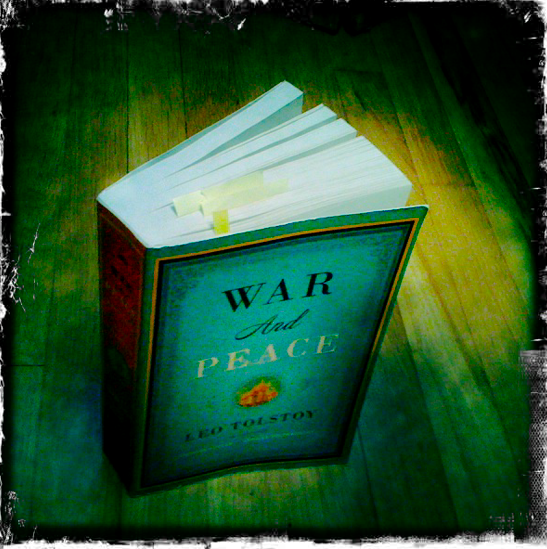
I'm officially in. I've been on the fence about joining this readalong, hosted by Allie at A Literary Odyssey, but a Barnes and Nobel giftcard from my mother-in-law (yeah, she's awesome) made up my mind for me. I bought the translation we are reading (I know it didn't have to be that one, but I had heard great things) and I just got it in the mail. Here's the reading schedule...
  • January 15, 2011: The first check-in will focus on volume 1. In my edition it is about 295 pages.
  • January 31, 2011: The second check-in will focus on volume 2. In my edition it is about 306 pages.
  • February 12, 2011: The third check-in will focus on volume 3. In my edition it is about 332 pages (the longest section).
  • February 28, 2011: The fourth check-in will cover volume 4 and the 2-part epilogue. These sections are about 282 pages in my edition.
So I will be diving into this massive book and hopefully loving every minute of it. If any of you want to join in, visit's Allie's blog for more details.

Photo by moi.

Book Reviews: Madame Bovary

Tuesday, October 19, 2010


Madame Bovary

by Gustave Flaubert
★★★★☆


I read this Lydia Davis translation of Madame Bovary as part of the read-along hosted by Nonsuch Book.

Let me begin with saying sometimes it’s hard to read classics because there are so many references to their plots mentioned in other books and movies, that when you finally read them you find out that you already know too much.

I started Madame Bovary already knowing the ending and much of the plot, which is unfortunate. I can only imagine how powerful this novel was for people who had no idea what was going to happen, especially when it first came out. That being said, I knew very little about the first half of the book and was surprised by quite a bit of the plot.

At the beginning we meet a sweet farm girl, Emma. Charles Bovary is married to a horrible woman and he falls for the lovely girl. After his wife passes away, Charles marries Emma, making her the title Madame Bovary (not to be confused with his first wife or his mother, both of which are frequently referred to as Madame Bovary).

Emma is infatuated with the idea of love, but neither she, nor her husband, actually understand what real love is. Emma expects something like the passionate affairs she’s read about in books. Charles’ version of a marriage is a simple relationship with little interaction beyond basic marital relations and discord. He expects very little from his wife and in return he gives her very little.

Soon Emma is completely disenchanted with married life. As a newlywed she wonders what will happen to her bridal bouquet when she dies. Later, feeling completely numb and emotionally dead, she burns the bouquet herself, demonstrating just how detached she’s become.

SPOILERS: The following comments discuss aspects in the Part II and III of the novel.

Emma is searching for something to save her from her boredom and she falls for a young man, Leon, with whom she has wonderful discussions. Soon he leaves, because she’s married, and she sets her sights on Roldolphe, a local bachelor, instead. He has decided he’ll take her as a mistress and sees their relationship as a casual one. She, on the other hand, sees him as her salvation. She’s miserable and hangs all of her hopes on him. When they decide to run away together she thinks of her daughter as a mere afterthought, she’s so wrapped up in her affair. She becomes more desperate and reckless as she feels her lover slipping away from her.

The scene at the opera was incredibly poignant to me. Emma watches the love affair unfold on the stage just as her own did, while her husband sits next to her, never comprehending what his wife is thinking.

The book begins and ends with Charles, which is fitting. He is completely oblivious to most of what happens in his wife’s life and she passes in and out of his life before he even knows what happened. He only lets himself see what he wants to see. He pictures Emma as an innocent doll, incapable of intentionally doing anyone harm. He’s both a victim and enabler in this tragic story. He does love his wife, or at least the idea of her, but he never really gets to know her, which just increases her isolation.

The real victims in the story are all of the people left behind when Emma is gone. Her daughter’s story was particularly sad. She’s no more than a footnote in most of the book and then at the end, she’s orphaned and alone in the world. Her selfish mother was never willing to put her daughter’s happiness before her own.

Even though, in the end, Emma proves herself to be self-absorbed and immature, I still loved the book. It was a wonderful portrait of a woman who begins with a romantic vision of love in her mind and is heartbroken by its realities. Instead of choosing to find meaning in her relationships and give them depth, she flits to other lovers hoping to find that illusive “romance.” She looks to wealth, spending money like she can buy happiness. She thrives on lies and the thrill of getting caught. She seeks only momentary pleasure and in doing so she ruins not only herself, but her whole family. Flaubert’s talent is obvious, because despite all of those things, we still care what happens to her.

One note on the translation:
I can't compare all of Lydia Davis' new translation to previous ones as this is my first time reading Madame Bovary. I did read a few of the same passages I’d highlighted in Davis’ translation in another copy of the book and found them to be very similar. But Davis certainly has an elegant way with words, which enhanced my experience with the book.

To participate in the rest of the read-along, visit Nonsuch Book here.

She will post on Part 2 on Thursday, Oct. 21 and on the final section on Thursday, Oct. 28.


Cranford Read-Along: Part 2

Wednesday, June 30, 2010


I didn't love Cranford at first. It felt trivial and slow. But half way through the book I realized that I loved these characters, our narrator Miss Smith, the gossipy Miss Pole and most of all, the gentle, trusting Miss Matty.

Here are my thoughts on the first half.

The book is made up of 16 chapters; each chronicles a small event in the quiet English town of Cranford in the 1840s. The women in the town are a tight-knit group, skeptical of outsiders and protective of each other. There are many humorous sections with mistaken identities, misunderstandings and unneeded panic, but those aren't the sections that will stay with me in years to come.

The chapter that finally hooked me was ch. 13 Stopped Payment. When a local bank has unexpected troubles we have a chance to see Miss Matty's goodness shine. She is so selfless in her concern for others that it broke my heart. Her sincere love for her friends and neighbors knows no bounds. When Miss Matty own finances seem dire, the dear ladies of Cranford come together to help her without her knowledge. That's the true heart of this sweet book, friendship that rises to the occasion, silently offering a shoulder to cry on or a hand to hold.

To me, this quote from Miss Pole summed up how the women of Cranford see themselves ...

"We, the ladies of Cranford, in my drawing-room assembled, can resolve upon something. I imagine we are none of us what may be called rich, though we all posses a genteel competency, sufficient for taste that are elegant and refined, and would not, if they could, be vulgarly ostentatious." - p. 160

This is my final post on Cranford for the read-along hosted by Allie at A Literary Odyssey. This was my first read-along and I loved it. I'll definitely be participating in more in the future.

I have the first disc of the BBC miniseries adaptation of Cranford at home and I can't wait to watch it. Has any one else seen it?

Cranford Read-Along: Part 1

Monday, June 14, 2010


This first post covers the first half of Cranford, chapters 1-8, for the read-along hosted by Allie at A Literary Odyssey.

The book consists of a sweet meandering through quiet country life in England in the 1840s. There's no major plot or drama, just 16 chapters of little anecdotes about the town of Cranford and its residents. Mary Smith, a young woman who frequently visits the town, is our narrator. The old women in the town, many of whom are spinsters or widows, rule the roost. Matty and Deborah Jenkyns are the elderly sisters at the heart of the book and their brother Peter plays a role in the story as well. I liked the chapter that deals with his deciding to leave Cranford forever.

I'm not enthralled by the book, but I really don't think I'm supposed to be. It reminds me quite a bit of Jane Austen's work, but without the romantic entanglements. It also has a similar feel to L.M. Montgomery's books (especially Anne of Windy Poplars). It's all about the social standing, fashion, etiquette, etc. I felt myself wishing there was a main character to become attached to. Austen had Elizabeth, Montgomery had Anne Shirley, but Cranford has only Mary and she has taken herself out of the action for the most part. It's about what she sees and what the other women do, not anything about herself.

I've still enjoyed it though. It's sweet and there's definitely a sarcastic humor, which I love. Here's a little snippet from chapter 8.

"The stars are so beautiful." (Miss Matty)

"Are you a fan of astronomy?" (Lady Glenmire)

"Not very," Miss Matty replied, rather confused at the moment to remember which was astronomy, and which was astrology - but the answer was true under either circumstance... she never could believe that the earth was moving constantly, and that she would not believe it if she could, it made her feel so tired and dizzy whenever she thought about it.

What did everyone else think?

My second and final post on the book will be done on Wednesday, June 30.

Cranford Read-Along

Monday, May 24, 2010


I've decided to participate in a read-along hosted by Allie at A Literary Odyssey. I've been wanting to read this for awhile, especially since I bought a beautiful copy, part of the new Penguin cloth-covered classics series.

(Cranford is the green one in the front)

Here's Amazon's summary of the book: A novel by Elizabeth Cleghorn Gaskell, published serially in Charles Dickens' magazine Household Words from 1851 to 1853 and in book form in 1853. Basing her tales on the village in which she was reared, Gaskell produced a gently comic picture of life and manners in an English country village during the 1830s. The novel's narrator (a young woman who periodically visits Cranford) describes the small adventures in the lives of two middle-aged sisters in reduced circumstances who do their best to maintain their standards of propriety, decency, and kindness. Using an intimate, gossipy voice that never turns sentimental, Gaskell conveys the old-fashioned habits, subtle class distinctions, and genteel poverty of the townspeople. Cranford quickly became one of the author's best-loved works.

Allie has set the following reading schedule:
Since Cranford is a relatively short book, I decided to have two days for posting. There are 16 chapters, so a post on chapters 1-8 can be made on June 15th (a Tuesday). The second and final posting can be done on June 30th (a Wednesday).

To join in on the fun, sign up here.